by NFS | Jan 17, 2012 | Archives
The Department of Revenue has planned an extensive two-month series of presentations to educate taxpayers 65 and older about the benefits of the Senior Circuit Breaker Tax Credit.
For tax year 2011, the credit is worth as much as $980 for eligible taxpayers 65 and older who either own or rent their home. The credit is refundable, meaning that if a taxpayer does not have an offsetting state tax liability, or has a liability that is smaller than the credit, they receive a check from the Commonwealth for either the entire credit or for the portion left after taxes are paid.
Seniors who live in public or subsidized housing are not eligible for the credit.
In tax year 2009, 80,566 taxpayers received $61.1 million in tax credits, an average of $759 per taxpayers. For more information on how the credit works and is calculated, go to this OpenDOR blog post.
Brian Lynch, of DOR’s office of Advocacy, Training and Communication, will conduct 14 sessions on the credit in various Massachusetts Council on Aging (COA) offices. We hope to see you there!
Here’s the complete schedule:
Jan 18 1:00 p.m., Wellesley COA, 219 Washington St., 781-235-3961.
Jan 19 1:00 p.m., Plainville COA, 9 School St., 508-699-7384
Jan 20 1:00 p.m., Waltham COA , 488 Main St., 781-899-7228
Jan 25 1:00 p.m, Wayland COA, 4 Cochituate Rd., 508-358-2990
Jan 30 1:00 p.m, Bedford COA, 12 Mudge Way, 781-275-6825
Feb 1 12:30 p.m., Wrentham COA , 400 Taunton St., 508-384-5425
Feb 6 10:00 a.m., Carlisle COA, 66 Westford St., 978-371-2895
Feb 6 1:00 p.m., North Attleboro COA, 204 Elm St., 508-699-0131
Feb 7 10:00 a.m., Attleboro COA, 25 South Main St., 508-223-2235
Feb 7 1:00 p.m., Norfolk COA, 28 Medway Branch Rd., 508-528-4430
Feb 8 10:30 a.m., Chelmsford COA, 75 Groton Rd., 978-251-0533
Feb 15 11:00 a.m., Concord Senior Center, 1276 Main St., 978-318-0856
Feb 17 10:00 a.m., Franklin COA, 10 Daniel McCahill St., 508-520-4945
Feb 22 1:00 p.m., Natick COA, 90 Oak St., 508-647-6540

by NFS | Jan 16, 2012 | Archives
You can benefit from a tax credit if you contribute to a given individual retirement arrangement or a retirement plan. However, the amount that you get will greatly depend on your credit rate and the amount that you contribute. The amount that you get in a year cannot exceed the amount of tax that you would have settled on that particular year. You will also not be entitled to tax credit if some other non-refundable credits reduce your tax liability to zero.
For you to claim a tax credit, there are some requirements that you must fulfill…
You should not be fully enrolled as a student- a full time student is one who is in a school with other regular students. There should also be some teaching staff who should be assisting in going through the course study. You are also a full time student if you are enrolled full time in a training course that is being offered by local government, state or a county. The period put into consideration in both cases is five months and these do not necessarily need to run consecutively.
Adjusted Gross Income (AGI) – for you to claim a tax credit, your AGI should not exceed:
- $56,500 when you are married but filing jointly
- $42,375 when you are filing as household head
- $28,250 when you are married but filing separately and if you are single or a widow/widower
How much credit can you get?
As stated earlier, the amount that you can receive on tax credit will depend on the credit rate that you have and the amount that you contribute. The credit rate on the other hand depends on the filing status together with the income of the individual involved and this can fall anywhere between 10% and 50%. You can easily search online for a form that will help you in calculating your credit rate if you need to know this.
If you have a retirement plan that you contribute to, you should know that it is possible to claim some tax credit and this can really help you to sort out some financial needs rather than applying for funding. You shouldn’t be afraid of claiming such as this will not have any effect on any other tax credits. However, you should ensure that you satisfy all the other mentioned requirements and this will see the whole process run smoothly.

by NFS | Jan 13, 2012 | Archives
What is The Child Tax Credit?
http://archive.constantcontact.com/fs088/1102707121899/archive/1109072154741.html

by NFS | Jan 13, 2012 | Archives
Education Tax Rules
Parents facing college expenses have several provisions in the tax law to consider. The benefits don’t apply to all, but there is something of interest for many families.
Tax Credits
The Hope credit (renamed the American Opportunity Tax Credit) is available for certain tuition and fees, and it allows you to reduce taxes annually up to $2,500 per student for four years of college. The credit is equal to 100% of the first $2,000 of qualified expenses and 25% of the next $2,000.
The lifetime learning credit covers any year of post-secondary education, with a maximum credit of $2,000, no matter how many students in the family are eligible.
Both the American Opportunity Tax Credit and lifetime learning credits phase out for taxpayers with higher incomes.
Other Education Tax Incentives
Education savings accounts. You may establish an education savings account (previously called an education IRA) with a nondeductible contribution for any child under 18. The annual contribution limit is $2,000. Funds can accumulate and be paid out tax-free for qualified college expenses, including tuition, fees, books, supplies, equipment, and certain room and board costs. The funds can also be used to pay for elementary and secondary (K-12) school expenses at public, private, or religious schools. Eligibility for an education savings account starts phasing out at $95,000 of AGI for single taxpayers and $190,000 for married folks.
Individual retirement accounts (IRAs). Existing IRAs can also be a source of college funds. You may make withdrawals before age 59½ without penalty for amounts paid for college or graduate school tuition, fees, books, room and board, supplies, and equipment.
Education savings bonds. Interest on Series EE and Series I bonds issued after 1989 is nontaxable when used to pay tuition and fees for you or your dependents. This tax break begins to phase out once income reaches certain levels.
Section 529 plans allow individuals to set up an account on behalf of someone else (say a child or grandchild) that can be used to pay college expenses. There are two types of plans:
Prepaid tuition plans are designed to hedge against inflation. You can purchase tuition credits, at today’s rates, that your child can redeem when he or she attends one of the plan’s eligible colleges or universities. Both state and private institutions can offer prepaid tuition programs. Using tuition credits from these programs is tax-free.
College savings plans are state-sponsored plans that allow you to build a fund to pay for your child’s college education. Your contributions are not tax-deductible, but once in the plan, your money grows tax-free. Provided the funds are used to pay for qualified college expenses, withdrawals are tax-free. Qualified expenses include tuition, fees, books, supplies, and certain room and board costs. Private institutions are not allowed to set up college savings accounts.
Student loan interest deduction. Interest on certain student loans can be deducted whether or not you itemize your deductions. The maximum deduction is $2,500 per year over the loan repayment period.
Other tax benefits. Most scholarships remain tax-free, nontaxable employer-paid tuition may be available, and education expenses related to your job still may be deductible.
When you start examining your situation, remember that many of these provisions are designed so that you can’t benefit from more than one in any given year. We can help guide you through the maze and help ensure that you receive the maximum possible benefit.
Please let me know if you have any questions or need assistance.

by NFS | Jan 12, 2012 | Archives
January is a good time to review your finances for the previous year and start organizing the documents and information you’ll need for preparing your tax return. One technique I’ve been using with some of my clients is to make a list of various types of income and tax-deductible expenses you had for 2011.
When your tax documents arrive in the mail, you can check them off your list. In this way you’ll know when all your documents have arrived, and then you’ll be ready to file your tax return.
This technique is especially useful if you have lots of documents, as it can help both you and me, your tax preparer, ensure that all items have been accounted for.
Now each person’s checklist will look a little bit different, since we all have slightly different financial situations.
Here’s one sample checklist for married homeowners:
- W-2 for the husband
- W-2 for the wife
- 1099-INT for savings account
- 1098 for mortgage interest paid
- Property tax statements
- Receipts for any energy-efficient home improvements
Once you develop your checklist, you’ll be able to tell when you have all your documents ready, and you’ll be able to cross-check your progress in your tax software or be able to cross-check your tax preparer’s work.
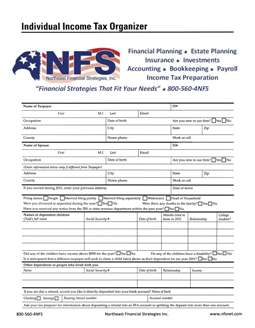
Your checklist can be as detailed or as simple as you need it to be. If you want to avoid having to create your own checklist, you can download a copy of my organizer here.