by NFS | Aug 7, 2013 | Archives
 If you plan to start a new business, or you’ve just opened your doors, it is important for you to know your
federal tax responsibilities. Here are five basic tips from the IRS that can help you get started.
- Type of Business. Early on, you will need to decide the type of business you are going to establish. The most common types are sole proprietorship, partnership, corporation, S corporation and Limited Liability Company. Each type reports its business activity on a different federal tax form.
- Types of Taxes. The type of business you run usually determines the type of taxes you pay. The four general types of business taxes are income tax, self-employment tax, employment tax and excise tax.
- Employer Identification Number. A business often needs to get a federal EIN for tax purposes. Check IRS.gov to find out whether you need this number. If you do, you can apply for an EIN online.
- Record-keeping. Keeping good records will help you when it’s time to file your business tax forms at the end of the year. They help track deductible expenses and support all the items you report on your tax return. Good records will also help you monitor your business’ progress and prepare your financial statements. You may choose any record-keeping system that clearly shows your income and expenses.
- Accounting Method. Each taxpayer must also use a consistent accounting method, which is a set of rules that determine when to report income and expenses. The most common are the cash method and accrual method. Under the cash method, you normally report income in the year you receive it and deduct expenses in the year you pay them. Under the accrual method, you generally report income in the year you earn it and deduct expenses in the year you incur them. This is true even if you receive the income or pay the expenses in a future year.
For more information or for assistance in getting your small business started, please contact our office for help.

by NFS | Aug 7, 2013 | Archives
 If you make a work-related move this summer, you may be able to deduct the costs of the move. This may
apply if you move to start a new job or to work at the same job in a new job location. The IRS offers the following tips on moving expenses you may be able to deduct on your tax return.
In order to deduct moving expenses, you must meet these three requirements:
- Your move closely relates to the start of work. Generally, you can consider moving expenses within one year of the date you first report to work at a new job location. Additional rules apply to this requirement.
- You meet the distance test. Your new main job location must be at least 50 miles farther from your former home than your previous main job location was. For example, if your old main job location was three miles from your former home, your new main job location must be at least 53 miles from that former home.
- You meet the time test. After you move, you must work full time at your new job location for at least 39 weeks during the first year. Self-employed individuals must meet this test and also work full time for a total of at least 78 weeks during the first 24 months upon arriving in the general area of their new job location. If your income tax return is due before you have satisfied this requirement, you can still deduct your allowable moving expenses if you expect to meet the time test.
See Publication 521, Moving Expenses, for more information about these rules. If you can claim this deduction, here are a few more tips from the IRS:
- Travel. You can deduct transportation and lodging expenses for yourself and household members while moving from your former home to your new home. You cannot deduct the cost of meals during the travel.
- Household goods. You can deduct the cost of packing, crating and transporting your household goods and personal property. You may be able to include the cost of storing and insuring these items while in transit.
- Utilities. You can deduct the costs of connecting or disconnecting utilities.
- Nondeductible expenses. You cannot deduct as moving expenses any part of the purchase price of your new home, the costs of buying or selling a home, or the cost of entering into or breaking a lease. See Publication 521 for a complete list.
- Reimbursed expenses. If your employer reimburses you for the costs of a move for which you took a deduction, you may have to include the reimbursement as income on your tax return.
- Update your address. When you move, be sure to update your address with the IRS and the U.S. Postal Service to ensure you receive mail from the IRS. File Form 8822, Change of Address, to notify the IRS.
- Tax form to file. To figure the amount of your deduction for moving expenses, use Form 3903, Moving Expenses.
More details are available in IRS Publication 521 and Form 3903. IRS publications and forms are available on IRS.gov or by calling 800-829-3676.
For a detailed Moving Guide from NFS, please request one here.

by NFS | Aug 5, 2013 | Archives
 Being in debt isn’t necessarily a terrible thing. Between mortgages, car loans, credit cards, and student loans
– most people are in debt. Being debt-free is a great goal, but you should focus on the management of debt, not just getting rid of it. It’s likely to be there for most of your life – and, handled wisely, it won’t be an albatross around your neck.
You don’t need to shell out your hard-earned money for exorbitant interest rates, or always feel like you’re on the verge of bankruptcy. You can pay off debt the smart way, while at the same time saving money to pay it off faster.
Know Where You Are
First, assess the depth of your debt. Write it down, using pencil and paper, a spreadsheet like Microsoft Excel, or a bookkeeping program like Quicken. Include every financial situation where a company has given you something in advance of payment, including your mortgage, car payment(s), credit cards, tax liens, student loans, and payments on electronics or other household items through a store.
Record the day the debt began and when it will end (if possible), the interest rate you’re paying, and what your payments typically are. Add it all up, painful as that might be. Try not to be discouraged! Remember, you’re going to break this down into manageable chunks while finding extra money to help pay it down.
Identify High-Cost Debt
Yes, some debts are more expensive than others. Unless you’re getting payday loans (which you shouldn’t be), the worst offenders are probably your credit cards. Here’s how to deal with them.
• Don’t use them. Don’t cut them up, but put them in a drawer and only access them in an emergency.
• Identify the card with the highest interest and pay off as much as you can every month. Pay minimums on the others. When that one’s paid off, work on the card with the next highest rate.
• Don’t close existing cards or open any new ones. It won’t help your credit rating.
• Pay on time, absolutely every time. One late payment these days can lower your FICO score.
• Go over your credit-card statements with a fine-tooth comb. Are you still being charged for that travel club you’ve never used? Look for line items you don’t need.
• Call your credit card companies and ask them nicely if they would lower your interest rates. It does work sometimes!
Save, Save, Save
Do whatever you can to retire debt. Consider taking a second job and using that income only for higher payments on your financial obligations. Substitute free family activities for high-cost ones. Sell high-value items that you can live without.
Do Away with Unnecessary Items to Reduce Debt Load
Do you really need the 800-channel cable option or that dish on your roof? You’ll be surprised at what you don’t miss. How about magazine subscriptions? They’re not terribly expensive, but every penny counts. It’s nice to have a library of books, but consider visiting the public library or half-price bookstores until your debt is under control.
Never, Ever Miss a Payment
Not only are you retiring debt, but you’re also building a stellar credit rating. If you ever move or buy another car, you’ll want to get the lowest rate possible. A blemish-free payment record will help with that. Besides, credit card companies can be quick to raise interest rates because of one late payment. A completely missed one is even more serious.
Do Not Increase Debt Load
If you don’t have the cash for it, you probably don’t need it. You’ll feel better about what you do have if you know it’s owned free and clear.
Shop Wisely, and Use the Savings to Pay Down Your Debt
If your family is large enough to warrant it, invest $30 or $40 and join a store like BJ’s or Costco. And use it. Shop there first, then at the grocery store. Change brands if you have to and swallow your pride. Use coupons religiously. Calculate the money you’re saving and slap it on your debt.
Each of these steps, taken alone, probably doesn’t seem like much. But if you adopt as many as you can, you’ll watch your debt decrease every month.

by NFS | Jul 26, 2013 | Archives
 |
Guest Blogger
Amy Maricle |
Decision making can be a trying process for some of us. While many people are decisive, take action, and never look back, others hem and haw over career changes, how they feel about a potential partner, and even what to order for lunch. Whatever your decision making personality, taking the time to tune into your own inner wisdom can assist you in making positive choices that you feel satisfied with today, and years from now.
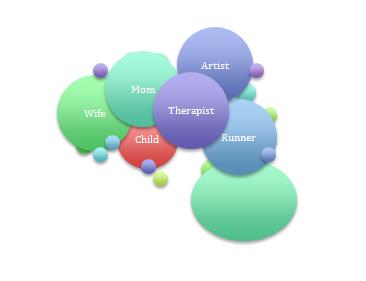
Mixed thoughts and feelings are what we usually refer to as ambivalence. Merriam Webster’s Online Dictionary defines ambivalence as: “Simultaneous and contradictory attitudes or feelings (as attraction and repulsion) toward an object, person, or action.” How can we feel opposite things at the same time? From a psychological standpoint, we all have separate, but overlapping parts of self, which we develop to serve different purposes. For example, I have a therapist, artist, wife, mother, child, and runner part, etc. You can visualize these parts of self as semi-overlapping circles that share certain skills, attributes, fears, insecurities, and habits. To get a clearer picture of this, think of how you behave at work – your tone of voice, word choice, posture, and timing. Now think of how you behave with your pet or your children at home. How would your child respond if you said, “I’d like you to consider moving nap time to somewhere in the window of 3 – 5 pm on weekends, as this would facilitate both afternoon chore productivity and morning play time.” Or vice versa, how would a colleague
respond if you approached them the way you talk to your dog? “What a good employee! You met all your productivity deadlines this week! Good employee! Come get a bonus!” Thankfully, we can choose which parts of self to use in different contexts.
Because our parts overlap, more than one part often has something to say about a given decision. Let’s say you have inherited a little money, and are faced with a choice about how best to use it. The fun-loving child part of you says, “Go on a vacation! You deserve it. Life is meant to be lived.” The responsible, parent part might say, “Don’t be so selfish, invest and build up some money for your daughter’s college tuition,” and then a fearful part might say, “If you don’t invest in your retirement, your daughter won’t have anywhere to visit you because you’ll be living on the street!” Which of these voices is “right?” All of them are. The trick is to weed through berating, belittling, or shaming voices and decide if there is a nugget of wisdom there, or just the stones of self-doubt. Once you do that, you can sift through all of the information logically and decide on the best course of action.
How do you let these parts or voices be heard? To explore them, discover how they can help you make better decisions, and use existing strengths in different parts of your life, try the following exercise.
Create a parts map:
Draw a circle on the middle of a page. This represents what I will call your “core self,” the center of you, so to speak. Now draw an overlapping circle and label it with one of your roles (i.e. daughter/son, mother/father, student, employee, cat lover, athlete, skeptic, activist, etc.) Continue drawing overlapping circles until you feel you have represented the major roles/parts of self. Now label some of the qualities, both positive and negative that each part exhibits. Use colors, shapes, and symbols to make your map more illustrative and rich. You could also draw each circle on a separate page so that you can manipulate which circles overlap, depending on the qualities they share.MaricleFigure1
You may find that different parts of self have different strengths that could be used in other parts of your life. For example, in my work life, I have always felt confident and stable. I expect that good things will come my way, and they always have. In contrast, in my love life, I used to fear being left. This clouded my choice in partners and my behavior in relationships. I frequently felt hurt, abandoned, and dissatisfied. At some point, I began using my work self’s positive and secure attitude in my personal life. Using elements of my work self, I was able to let go of my desire to meet someone on a certain timeline, and of course, that’s when I met someone. This is a “fake it till you make it” approach in the beginning, but eventually it will come naturally. These are all parts of you, after all.
Getting a good understanding of different parts can assist you in listening to your own wisdom. You can clear away voices of self-doubt and unfounded negativity, making a path for new endeavors by heeding the inner wisdom that helps you avoid pitfalls and make positive choices.
Amy Johnson Maricle, LMHC, ATR-BC is a psychotherapist and art therapist in Foxboro, MA. She loves helping teens and adults find ways to live happier, healthier, and smarter. You can find out more at: www.amyjohnsonmaricle.com
(Originally posted on First30Days Blog, July 8th, 2013)
DISCLAIMER: This information is not a substitute for professional psychological advice, diagnosis, or treatment. All content provided by Maricle Counseling and Amy Maricle, LMHC, ATR-BC is intended for general information purposes only. Never disregard professional medical or psychological advice or delay seeking treatment because of something you read here.

by NFS | Jul 22, 2013 | Archives
Whether you roll the dice, play cards or bet on the ponies, all your winnings are taxable. The IRS offers these six tax tips for the casual gambler.
1. Gambling income includes winnings from lotteries, raffles, horse races and casinos. It also includes cash and the fair market value of prizes you receive, such as cars and trips.
2. If you win, you may receive a Form W-2G, Certain Gambling Winnings, from the payer. The form reports the amount of your winnings to you and the IRS. The payer issues the form depending on the type of gambling, the amount of winnings, and other factors. You’ll also receive a Form W-2G if the payer withholds federal income tax from your winnings.
3. You must report all your gambling winnings as income on your federal income tax return. This is true even if you do not receive a Form W-2G.
4. If you’re a casual gambler, report your winnings on the “Other Income” line of your Form 1040, U. S. Individual Income Tax Return.
5. You may deduct your gambling losses on Schedule A, Itemized Deductions. The deduction is limited to the amount of your winnings. You must report your winnings as income and claim your allowable losses separately. You cannot reduce your winnings by your losses and report the difference.
6. You must keep accurate records of your gambling activity. This includes items such as receipts, tickets or other documentation. You should also keep a diary or similar record of your activity. Your records should show your winnings separately from your losses.
Please contact our office for information or help on this topic.