
Seasons Greetings from NFS!
http://ping.fm/eIE2i
Special Needs Planning: First Steps in NFS Retirement Readings
http://ping.fm/D6ao8

Payroll Tax Cut to Boost Take-Home Pay for Most Workers; New Withholding Details Now Available
WASHINGTON ― The Internal Revenue Service today released instructions to help employers implement the 2011 cut in payroll taxes, along with new income-tax withholding tables that employers will use during 2011.
 Millions of workers will see their take-home pay rise during 2011 because the Tax Relief, Unemployment Insurance Reauthorization, and Job Creation Act of 2010 provides a two percentage point payroll tax cut for employees, reducing their Social Security tax withholding rate from 6.2 percent to 4.2 percent of wages paid. This reduced Social Security withholding will have no effect on the employee’s future Social Security benefits.
 The new law also maintains the income-tax rates that have been in effect in recent years.
Employers should start using the new withholding tables and reducing the amount of Social Security tax withheld as soon as possible in 2011 but not later than Jan. 31, 2011. Notice 1036, released today, contains the percentage method income tax withholding tables, the lower Social Security withholding rate, and related information that most employers need to implement these changes. Publication 15, (Circular E), Employer’s Tax Guide, containing the extensive wage bracket tables that some employers use, will be available on IRS.gov in a few days.
The IRS recognizes that the late enactment of these changes makes it difficult for many employers to quickly update their withholding systems. For that reason, the agency asks employers to adjust their payroll systems as soon as possible, but not later than Jan. 31, 2011.
For any Social Security tax over withheld during January, employers should make an offsetting adjustment in workers’ pay as soon as possible but not later than March 31, 2011.
Employers and payroll companies will handle the withholding changes, so workers typically won’t need to take any additional action, such as filling out a new W-4 withholding form.
As always, however, the IRS urges workers to review their withholding every year and, if necessary, fill out a new W-4 and give it to their employer. For example, individuals and couples with multiple jobs, people who are having children, getting married, getting divorced or buying a home, and those who typically wind up with a balance due or large refund at the end of the year may want to consider submitting revised W-4 forms. Publication 919, How Do I Adjust My Tax Withholding?, provides more information to workers on making changes to their tax withholding. As always, if you need assistance with your withholdings, or any other tax & financial situation, please do not hesitate to contact me at 800-560-4NFS extension 14.

White House Plans to Scale Back Tax Cut Extension in 2012
Washington, D.C – Vice President Joe Biden indicated the Obama administration intends to limit the newly extended tax cuts when they come up again for renewal in 2012.
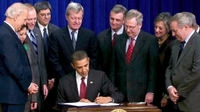
President Obama signed an extension of the Bush-era tax cut rates on Friday after the House passed the legislation Thursday night (see House Passes Extension of Bush Tax Cuts and Unemployment Rates). The legislation, which largely abided by a framework agreement that President Obama struck with Senate Minority Leader Mitch McConnell, R-Ken., earlier this month, extended the current income, dividend and capital gains tax rates for another two years, even for those making over $250,000 a year, along with setting the estate tax at 35 percent for estates over $5 million.
In return, Republican congressional leaders agreed to support some of the Obama administration’s priorities in the legislation, including a 13-month extension of unemployment benefits, and a 2 percentage point cut in Social Security payroll taxes for a year from 6.2 to 4.2 percent. The bill also provides extensions of the Child Tax Credit, the Earned Income Tax Credit, the American Opportunity Tax Credit for college tuition, the Research & Experimentation Credit, and a host of other tax extender items; a two-year patch to the alternative minimum tax; and 100 percent bonus depreciation expensing of business investments in plant and equipment for 2011 and 50 percent for 2012.
However, the Obama administration has long opposed extending the Bush tax cuts for those making over $250,000 a year. Biden made clear that the administration would oppose the extension of those rates beyond 2012, even in an election year, as well as the 35 percent estate tax rate. Speaking to NBC White House correspondent David Gregory on “Meet the Press” on Sunday, Biden said, “The one target for us in two years is no longer extending the upper-income tax credit for millionaires and billionaires, and scaling back what we had to do to get the compromise, the estate tax for the very wealthy.”
Asked whether he thought anybody in Congress would vote in an election year not to extend the tax cuts, Biden insisted they would as a result of the work of the bipartisan deficit commission, which recently gave its recommendations on ways to cut the federal budget deficit. “I think what’ll be different is that we will have had the outcome of the deficit commission,” he said. “We will be able to make the case much more clearly that spending $700 billion over 10 years to extend tax cuts for people whose income averages well over a million dollars does not make sense.”
On Friday, McConnell and several other Republican legislators attended the White House signing ceremony for the tax cut extension, a rarity so far in the Obama administration, but also a signal that the Republican leadership in Congress may be willing to work with the administration on some issues where there is common ground.
At the signing ceremony, Biden jokingly referred to an earlier impromptu remark he had made during the signing ceremony for the health care reform bill, in which a microphone caught him mixing an expletive in with his enthusiastic comment.
“Ladies and gentlemen,” he said at Friday’s signing ceremony, “this is a — I wasn’t going to say, ‘a big deal,’ but an important deal. I can no longer say ‘big deal.’ Thank god, my mother wasn’t around.”
Biden commended McConnell and the other Republicans in attendance, including Rep. Dave Camp, R-Mich., who is expected to chair the tax-writing House Ways and Means Committee in January, for agreeing to work with the administration on the tax cut package.
“This package is a result of leaders from both sides coming together to act on behalf of the American people at a time they need it most,” he said. “I want to begin by applauding Senator Mitch McConnell, and the other Republican leaders, who like their Democratic counterparts who are here today, were willing to take issue with some of their own party and to do what was, in their view, necessary in order to move the country forward. That’s what the American people expect of all of us, especially in these times. And that’s what we’ve done here. It means accepting some things we don’t like in order to get the job done for Americans as needs to be done.”
Obama echoed Biden’s comment that the administration had settled for some provisions of the deal to which it was initially opposed. “Now, candidly speaking, there are some elements of this legislation that I don’t like,” he said. “There are some elements that members of my party don’t like. There are some elements that Republicans here today don’t like. That’s the nature of compromise — yielding on something each of us cares about to move forward on what all of us care about. And right now, what all of us care about is growing the American economy and creating jobs for the American people. Taken as a whole, that’s what this package of tax relief is going to do. It’s a good deal for the American people. This is progress. And that’s what they sent us here to achieve.”
By Michael Cohn
Accounting Today

Excuses, Excuses
Time to stop the excuses! Watch this fun web movie that features that little inner voice we all have that tells us to stop making excuses and start protecting what’s most valuable to us – the future of our loved ones.
When you are finished watching the video, give me a call and we can chat about getting your life insurance plan set up TODAY.
800-560-4NFS x 14

Voted Best Accountant, Financial Planner & Insurance Agency in Wrentham 2011-2020 & Regional Favorite 2016-2020

Voted 2022 Local Businessperson of the Year in Wrentham by Alignable

Voted 2020-2021 Local Businessperson of the Year in Wrentham by Alignable

Voted Top 31 Insurance Agency in Providence RI Area
